[Source: http://ec.europa.eu/health/ageing/innovation/index_en.htm] Identifier: H2020-JTI-IMI2-2017-11-single-stagePillar: Societal ChallengesOpening Date: Deadline: Tue, 24 Oct 2017 17:00:00 (Brussels local time)Modification Date: Mon, 22 Jan 2018Latest information: An overview of the evaluation results (flash call info-IMI2 Call 11-single stage) is now available under the call ‘Additional documents’ tab
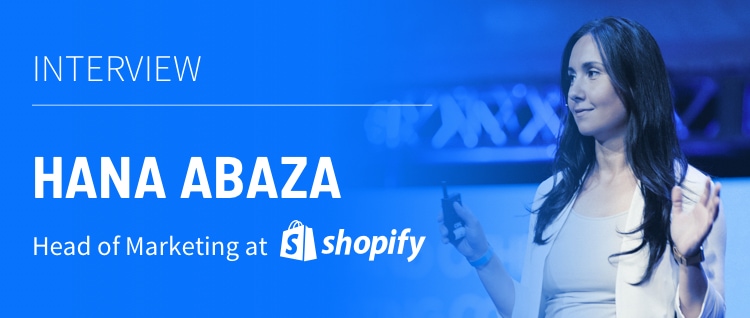
Product Marketing Lessons Learned: An Interview with Shopify’s Hana Abaza [Video]
Hana Abaza runs the marketing show over at Shopify Plus, the enterprise arm of e-commerce software giant Shopify. In the interview, we unpack some of the ways they’re increasing product awareness and adoption of a new product – including the genesis of the idea for Shopify Plus, and some product marketing lessons learned.

We also talk about MacGyvering, crazy startup ideas, and a ton of resources you can use for your own product marketing efforts.
Watch My Interview with Hana Abaza on Product Marketing Lessons Learned
Show Notes
Here are all the resources we talked about:
- 09:03 Jobs to be Done (JTBD) Framework | Framework
- 15:45 Product adoption tips
Some of Hana’s presentation slides. - 18:00 Partner Marketing
How Shopify leveraged their partners to create content to influence organic search for a new product. - 20:08 Marketing a product with no pricing on your website
Is it harder or easier to market an enterprise product when you only have a demo request? - 24:10 Who does product marketing well?
- 25:15 First Round Capital Interview with Joanna Lord
- 27:14 Intercom Product Marketing
- 30:13 MacGyvering
- 31:10 Who would Hana take to a deserted island?
The Unpublished David Ogilvy. - 33:50 Hana’s favourite dad joke
What do you call cheese that isn’t yours? Nacho Cheese!
Cheers
Get back here on Monday where I’ll be showing you how to use Sticky Bars to craft really cool mobile user experiences.
Eli Lilly’s Eiry Roberts Joins Neurocrine as Chief Medical Officer
Eiry Roberts is Neurocrine Biosciences’ (NASDAQ: NBIX) new chief medical officer. Roberts comes to the San Diego biotech company from Eli Lilly (NYSE: LLY), where her roles included serving as vice president of clinical pharmacology, and vice president of R&D in the company’s biomedicines business unit. Roberts succeeds Christopher O’Brien, who will retire in February. Neurocrine says O’Brien will continue in a consulting role to the company. Neurocrine develops and markets drugs that treat neurologic, psychiatric, and endocrine disorders.
UNDERWRITERS AND PARTNERS
Bio Roundup: Spark’s Road Ahead, Juno Rumors, Merck’s Big Day & More

The most overblown health story of the week was President Trump’s health exam. America learned Trump is in perfect health and has “great genes.” He takes Propecia. He doesn’t have heart problems, had a perfect cognitive test score, and is one pound shy of obese.
This scintillating information led to a new social media phenomenon, the “girther” movement, and a number of articles questioning the findings of longtime White House physician Ronny Jackson.
Meanwhile, there was life-science and biomedical news actually pertinent to the public health of the U.S. Spark Therapeutics is trying to influence how our healthcare… Read more »
UNDERWRITERS AND PARTNERS
Call for proposals for projects on protection of public spaces and addressing CBRN-E (chemical, biological, radiological, nuclear and explosives) threat
[Source: http://ec.europa.eu/health/ageing/innovation/index_en.htm] Identifier: ISFP-2017-AG-PROTECTPillar: Crisis and terrorismOpening Date: Deadline: Thu, 1 Feb 2018 17:00:00 (Brussels local time)Modification Date: Fri, 19 Jan 2018Latest information: Questions and Answers have been published.
You can find them under the Topic concistions and documents of the Topic : ISFP-2017-AG-PROTECT-Protection.
iBio, Inc. (IBIO) vs. Illumina, Inc. (ILMN): Breaking Down the Biotechnology Industry’s Two Hottest …
iBio, Inc. (NYSE:IBIO) and Illumina, Inc. (NASDAQ:ILMN) are the two most active stocks in the Biotechnology industry based on today’s trading volumes. We will compare the two companies based on the strength of various metrics, including growth, profitability, risk, return, and valuation to determine if …
CHURCHILL MANAGEMENT Corp Purchases 1244066 Shares of iShares NASDAQ …
iShares NASDAQ Biotechnology Index logo CHURCHILL MANAGEMENT Corp raised its holdings in iShares NASDAQ Biotechnology Index (NASDAQ:IBB) by 223.2% in the 4th quarter, according to its most recent 13F filing with the Securities & Exchange Commission. The firm owned 1,801,330 shares …
Digitising and transforming European industry and services: digital innovation hubs and platforms
[Source: http://ec.europa.eu/health/ageing/innovation/index_en.htm] Identifier: H2020-DT-2018-2020Pillar: Industrial LeadershipOpening Date: Deadline: Tue, 17 Apr 2018 17:00:00 (Brussels local time)Modification Date: Thu, 18 Jan 2018Latest information: The proposal templates part B section 4-5, related to the innovation actions of the topics DT-ICT-02-2018 and DT-ICT-07-2018, have been amended to include point 4.3. Financial support to third parties (FSTP).We kindly request you to use this new version of the templates for your proposals.
Bluegrass Vascular Opens U.S. Clinical Trial for Obstructed Veins

San Antonio-Bluegrass Vascular Technologies has started to enroll patients in a U.S. clinical trial for its catheter system for regaining access to obstructed veins.
Bluegrass says it eventually will study 30 patients at 10 research centers across the U.S. in the next year, including St. Joseph Hospital in Orange, CA, and Houston Methodist Hospital in Texas. The company can file for FDA approval after it collects the data from the trial, says president and CEO Gabriele Niederauer.
Bluegrass, founded in 2010, received regulatory clearance in Europe in 2016 and started selling its system, called the Surfacer Inside-Out Access Catheter System,… Read more »
UNDERWRITERS AND PARTNERS
Science Over Fiction: GMOs for Public Good

Devex reporter Lisa Cornish recently kicked off a four part series examining all sides of the GMO debate. In her first installment, Cornish starts by focusing on the science behind GMOs, explaining that the scientific community is one of the biggest proponents of GMO use.
Aside from the corporations profiting from GMOs, scientists are one of the most vocal groups in favor of the use of GMOs. In June 2016, 129 Nobel Laureates signed a letter urging Greenpeace to re-examine and abandon their campaign against GMOs. In their letter, they argue that there has never been any evidence of health issues associated with GMOs and the impact on the environment is less harmful than traditional agriculture. They also noted that GMO has the potential to greatly reduce death and disease from issues such as Vitamin A deficiency in developing countries.
Today, scientific research continues to find no health risk from GMOs and scientists are being urged to engage on the debate.
However, even with the support from the scientific community, organizations focused on marketing and promoting non-GMO products have been able to infiltrate public perception, creating an uphill battle for GMO advocates in reversing public opinion. Dr. Hugo Alonso, a researcher in plant genetics and physiology, explains his frustrations over the negative perceptions of GMOs:
Despite there being strong arguments for GMO to support the needs of the developing world, the perceptions of the developed world dominate – and GMO-free branding on products means consumers are more likely to be educated on why they need to avoid GMOs. It is a difficult education cycle to compete against. Combined with supermarkets full of food, Alonso said it is difficult to explain to consumers in developing countries why creating more food should be an important issue to them.
Cornish, and the scientists she interviewed for her coverage, argue that to change public perception GMO advocates should focus their messaging on the public good. Once consumers start to understand the global benefit of GMOs, such how it can help us achieve global food security, perceptions will likely shift. As evidence, the documentary Food Evolution, which explores both sides of the GMO debate and illustrates the social and community benefits in places like Hawaii and Uganda, seems to be reversing public opinion already.
At a screening at the Australian National University in Canberra last September, the audience were asked about their perspective on GMOs before the film – displaying a red, orange or green card to say if they were against, undecided or for GMOs. Red and orange dominated.
After the screening they were asked the question again – and a significant number were changed to green.
Read the full article here.